Colors
The film's code
import manimgx as m


class ColorsHero(m.Scene):
    def construct(self) -> None:
        rows = m.VGroup()
        for family in [
            "BLUE",
            "TEAL",
            "GREEN",
            "YELLOW",
            "GOLD",
            "RED",
            "MAROON",
            "PURPLE",
            "GREY",
        ]:
            row = m.VGroup(m.Text(family, font="monospace", font_size=24))
            for shade in "ABCDE":
                color = m.PALETTE[f"{family}_{shade}"]
                row.add(
                    m.Circle(radius=0.24, color=color, fill_opacity=1, stroke_width=0)
                )
            row.arrange(buff=0.16)
            rows.add(row)
        rows.arrange(m.DOWN, buff=0.16, aligned_edge=m.RIGHT)
        self.play(
            m.LaggedStart(
                *[m.FadeIn(row, shift=0.2 * m.RIGHT) for row in rows], lag_ratio=0.1
            )
        )
        self.wait()
A color is a name, such as m.BLUE; a hex code, such as "#58C4DD"; or numbers of red,
green and blue. Each takes the place of the others wherever a color goes:
m.Circle(color="#58C4DD") is m.Circle(color=m.BLUE).
Most named colors come in a family of five shades, from A, the lightest, to E, the darkest; the family's own name is its C. GRAY and GREY are two spellings of one color.
The named colors
WHITE
#FFFFFF
GRAY_AGREY_A
#DDDDDD
GRAY_BGREY_B
#BBBBBB
GRAY_CGREY_C
#888888
GRAY_DGREY_D
#444444
GRAY_EGREY_E
#222222
BLACK
#000000
LIGHTER_GRAYLIGHTER_GREY
#DDDDDD
LIGHT_GRAYLIGHT_GREY
#BBBBBB
GRAYGREY
#888888
DARK_GRAYDARK_GREY
#444444
DARKER_GRAYDARKER_GREY
#222222
PURE_RED
#FF0000
PURE_GREEN
#00FF00
PURE_BLUE
#0000FF
PURE_CYAN
#00FFFF
PURE_MAGENTA
#FF00FF
PURE_YELLOW
#FFFF00
BLUE_A
#C7E9F1
BLUE_B
#9CDCEB
BLUE_C
#58C4DD
BLUE_D
#29ABCA
BLUE_E
#236B8E
BLUE
#58C4DD
DARK_BLUE
#236B8E
TEAL_A
#ACEAD7
TEAL_B
#76DDC0
TEAL_C
#5CD0B3
TEAL_D
#55C1A7
TEAL_E
#49A88F
TEAL
#5CD0B3
GREEN_A
#C9E2AE
GREEN_B
#A6CF8C
GREEN_C
#83C167
GREEN_D
#77B05D
GREEN_E
#699C52
GREEN
#83C167
YELLOW_A
#FFF1B6
YELLOW_B
#FFEA94
YELLOW_C
#F7D96F
YELLOW_D
#F4D345
YELLOW_E
#E8C11C
YELLOW
#F7D96F
GOLD_A
#F7C797
GOLD_B
#F9B775
GOLD_C
#F0AC5F
GOLD_D
#E1A158
GOLD_E
#C78D46
GOLD
#F0AC5F
RED_A
#F7A1A3
RED_B
#FF8080
RED_C
#FC6255
RED_D
#E65A4C
RED_E
#CF5044
RED
#FC6255
MAROON_A
#ECABC1
MAROON_B
#EC92AB
MAROON_C
#C55F73
MAROON_D
#A24D61
MAROON_E
#94424F
MAROON
#C55F73
PURPLE_A
#CAA3E8
PURPLE_B
#B189C6
PURPLE_C
#9A72AC
PURPLE_D
#715582
PURPLE_E
#644172
PURPLE
#9A72AC
PINK
#D147BD
LIGHT_PINK
#DC75CD
ORANGE
#FF862F
LIGHT_BROWN
#CD853F
DARK_BROWN
#8B4513
GRAY_BROWNGREY_BROWN
#736357
LOGO_WHITE
#ECE7E2
LOGO_GREEN
#87C2A5
LOGO_BLUE
#525893
LOGO_RED
#E07A5F
LOGO_BLACK
#343434
m.PALETTE 
The named colors, by name: PALETTE["BLUE"] is BLUE. A color's name, in any case,
is read as the color.
Make a color
ManimColor 
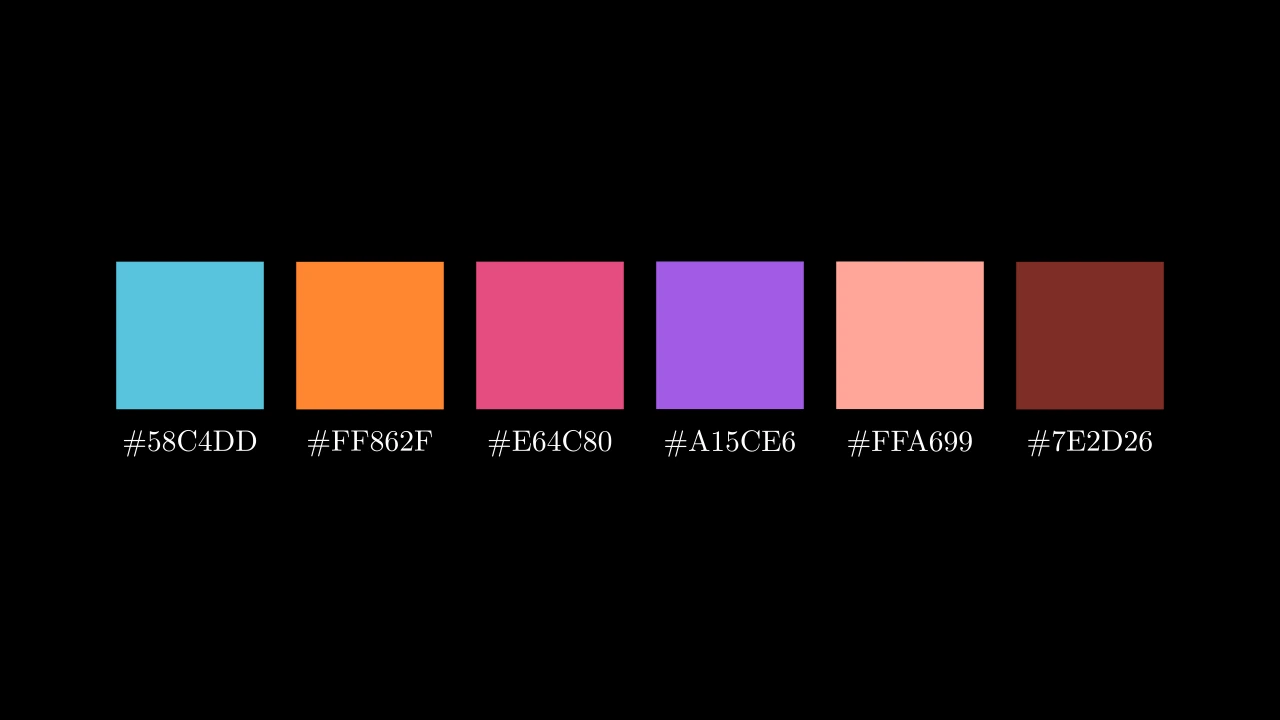
Code
import manimgx as m


class ManimColorExample(m.Scene):
    def construct(self) -> None:
        colors = [
            m.ManimColor("#58C4DD"),
            m.ManimColor("orange"),
            m.ManimColor((0.9, 0.3, 0.5)),
            m.ManimColor.from_hsv((0.75, 0.6, 0.9)),
            m.RED.lighter(0.4),
            m.RED.darker(0.4),
        ]
        swatches = m.VGroup(
            *(
                m.VGroup(
                    m.Square(side_length=1.6, color=color, fill_opacity=1),
                    m.Text(color, font_size=24),
                ).arrange(m.DOWN)
                for color in colors
            )
        )
        self.add(swatches.arrange(buff=0.4))
A color: red, green, blue and opacity, from 0 to 1, which is also its hex string.
As a string it is "#RRGGBB", or "#RRGGBBAA" when translucent, so it goes
wherever a string does; to_rgba gives its values.
ManimColor(value, alpha=1.0) reads value as a color, of opacity alpha (from 0
to 1) where value gives none. value is:
- a hex string,
"#FC6255"or"0xFC6255", of 3, 4, 6 or 8 digits (the fourth of four, and the last two of eight, are the opacity); - a color's name, in any case:
"BLUE","blue_c"; - an integer,
0xFC6255; - three or four numbers, red, green, blue and opacity: from 0 to 1 if all are
floats, from 0 to 255 otherwise (
(1.0, 0.5, 0.0)is orange,(1, 0.5, 0)nearly black); - another color, copied as it is;
- None, for black.
to_rgb 
to_rgba 
The color's red, green, blue and opacity.
Returns An array of four floats, from 0 to 1.
to_hex 
The color as a hex string, "#RRGGBB", in capitals.
with_alphaWhether to add the opacity's two digits:
"#RRGGBBAA".
Returns The string.
Source
src/manimgx/drawing/paint.py
interpolate 
The color a fraction of the way from this one to another, mixed as every blend of colors is: in OKLab, where the colors between two are those the eye sees between them.
otherThe color at 1.
alphaHow far toward it, from 0 (this color) to 1 (
other).
Returns A new color.
Source
src/manimgx/drawing/paint.py
opacity 
This color with another opacity.
opacityThe opacity, from 0 (transparent) to 1 (opaque).
Returns A new color.
Source
src/manimgx/drawing/paint.py
lighter 
This color mixed toward white, its opacity kept.
blendHow far toward white, from 0 (this color) to 1 (white).
Returns A new color.
Source
src/manimgx/drawing/paint.py
darker 
This color mixed toward black, its opacity kept.
blendHow far toward black, from 0 (this color) to 1 (black).
Returns A new color.
Source
src/manimgx/drawing/paint.py
from_hex 
The color of a hex string, read as the constructor reads it ("#RRGGBB",
"#RGB", with or without opacity digits; a color's name too).
hex_strThe string.
alphaThe opacity, from 0 to 1, if the string gives none.
Returns A new color.
Source
src/manimgx/drawing/paint.py
from_rgb 
The color of a red, green and blue.
rgbRed, green and blue, from 0 to 1.
alphaThe opacity, from 0 to 1.
Returns A new color.
Source
src/manimgx/drawing/paint.py
from_rgba 
The color of a red, green, blue and opacity.
rgbaRed, green, blue and opacity, from 0 to 1.
Returns A new color.
Source
src/manimgx/drawing/paint.py
from_hsv 
The color of a hue, saturation and value.
hsvHue, saturation and value, each a float from 0 to 1: a hue of 0 (or 1) is red, ⅓ green, ⅔ blue.
alphaThe opacity, from 0 to 1.
Returns A new color.
Source
src/manimgx/drawing/paint.py
from_hsl 
The color of a hue, saturation and lightness.
hslHue, saturation and lightness, each from 0 to 1: a hue of 0 (or 1) is red, ⅓ green, ⅔ blue; a lightness of 0.5 is the full color.
alphaThe opacity, from 0 to 1.
Returns A new color.
Source
src/manimgx/drawing/paint.py
to_hsv 
The color's hue, saturation and value.
Returns An array of three floats, from 0 to 1.
contrasting 
A color that stands out against this one, as text on it would: dark on a light color, light on a dark one.
thresholdThe luma (0.30 red + 0.59 green + 0.11 blue), from 0 to 1, above which this color counts as light.
lightThe color for a dark color; None for white.
darkThe color for a light color; None for black.
Returns
dark or light.
Source
src/manimgx/drawing/paint.py
invert 
The color's complement: each of red, green and blue taken from 1, the opacity kept.
Returns A new color.
HSV 
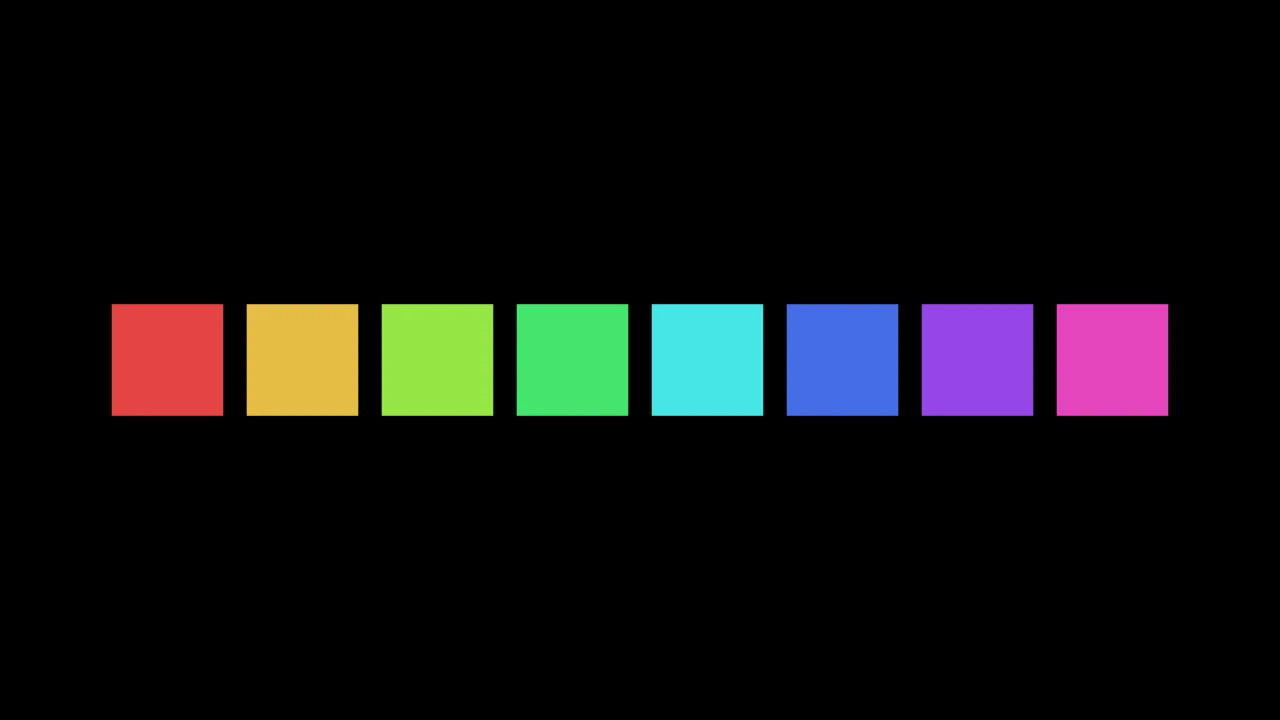
A color made from a hue, saturation and value, which can be read and set.
HSV(hsv, alpha=1.0) takes the hue, saturation and value, each from 0 to 1, and
the opacity: a fourth number of hsv, if given, or else alpha, from 0 to 1.
Setting hue, saturation or
value changes the color, as a value and as its str; it still
compares equal to (and hashes as) the string it was made as.
h 
The color's hue, from 0 to 1: 0 (or 1) red, ⅓ green, ⅔ blue. Set it to change the color.
hue 
The color's hue, from 0 to 1: 0 (or 1) red, ⅓ green, ⅔ blue. Set it to change the color.
s 
The color's saturation, from 0 (grey) to 1 (the full color). Set it to change the color.
saturation 
The color's saturation, from 0 (grey) to 1 (the full color). Set it to change the color.
v 
The color's value, from 0 (black) to 1 (the brightest). Set it to change the color.
value 
The color's value, from 0 (black) to 1 (the brightest). Set it to change the color.
Blend colors
interpolate_color 
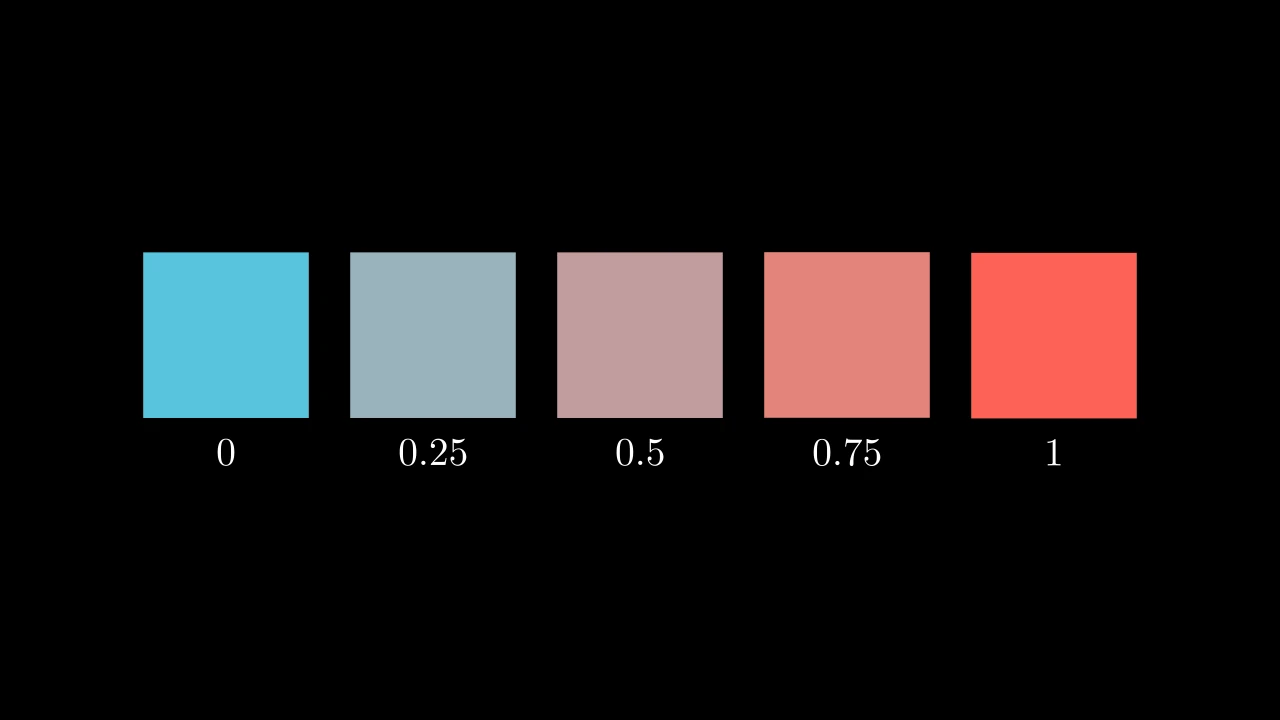
Code
import manimgx as m


class InterpolateColorExample(m.Scene):
    def construct(self) -> None:
        swatches = m.VGroup()
        for alpha in (0, 0.25, 0.5, 0.75, 1):
            color = m.interpolate_color(m.BLUE, m.RED, alpha)
            square = m.Square(side_length=1.8, color=color, fill_opacity=1)
            label = m.Text(str(alpha), font_size=32).next_to(square, m.DOWN)
            swatches.add(m.VGroup(square, label))
        self.add(swatches.arrange(buff=0.5))
The color a fraction of the way from one color to another.
The two mix as every blend of colors does: in OKLab, where the colors between two are those the eye sees between them.
aThe color at 0.
bThe color at 1.
alphaHow far from
atob, from 0 to 1.
Returns A new color.
Source
src/manimgx/drawing/paint.py
color_gradient 
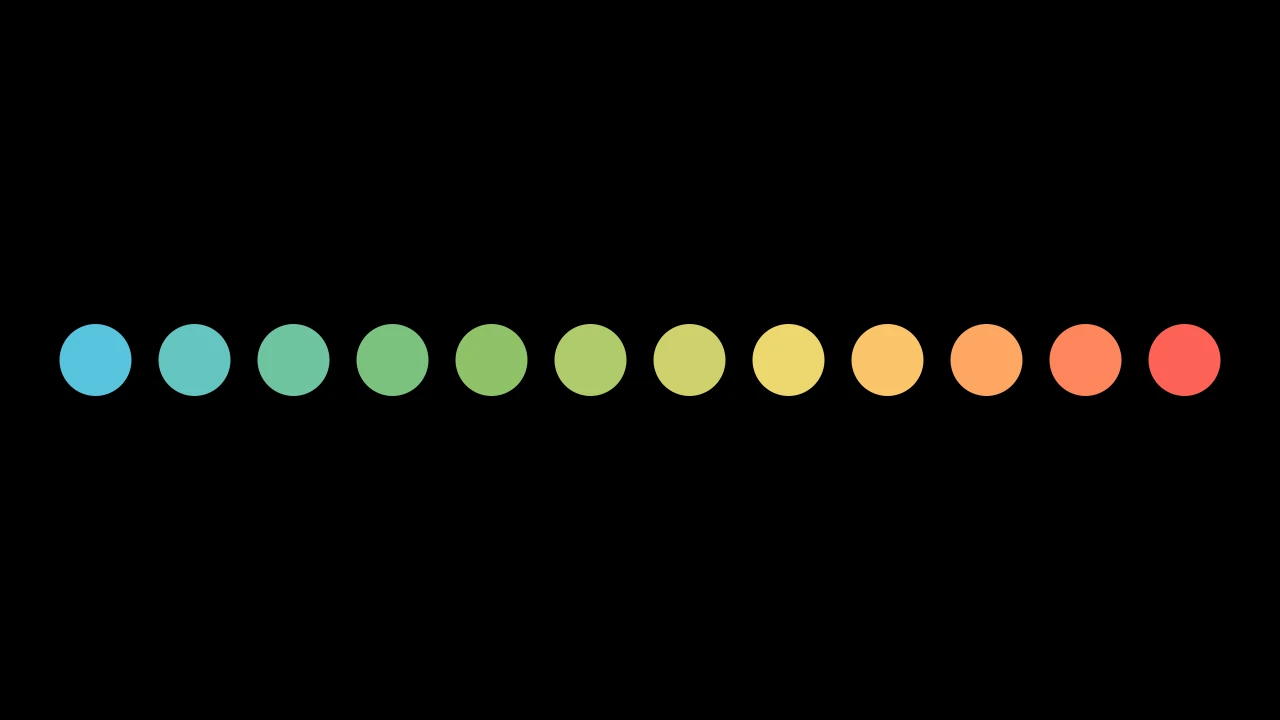
Colors evenly spaced along a gradient through reference colors, from the first to the last.
Each is mixed between the two reference colors on either side of it, as interpolate_color mixes them.
reference_colorsThe colors the gradient runs through, evenly spaced along it.
length_of_outputHow many colors to return; one is the last reference color.
Returns The colors, in order along the gradient.
Source
src/manimgx/drawing/paint.py
average_color 
The average of colors, taken in OKLab: the color the eye sees as their middle.
Their opacities are left out: the average is opaque.
*colorsThe colors, in any form ManimColor reads.
Returns A new, opaque color.
Source
src/manimgx/drawing/paint.py
invert_color 
A color's complement: each of red, green and blue taken from 1, the opacity kept.
colorThe color, in any form ManimColor reads.
Returns A new color.
Source
src/manimgx/drawing/paint.py
colors_by_value 
The color of each value on a colorscale: mixed between the colors on either side of it, and held beyond the colorscale's ends.
The colors mix as every blend of colors does: in OKLab, where the colors between two are those the eye sees between them.
colorscaleColors spread evenly from
lowtohigh, or (color, value) pairs, each color at its value, in increasing order of value.valuesThe values to color.
lowThe value of the first color, when the colors are spread evenly.
highThe value of the last color, when the colors are spread evenly.
Returns One color per value, in order.
Source
src/manimgx/drawing/paint.py
Choose colors at random
random_color 
A named color, drawn at random.
Python's random draws it, so random.seed makes it repeatable; see
RandomColorGenerator for a stream of its own.
Returns One of the named colors.
Source
src/manimgx/drawing/paint.py
random_bright_color 
A light color, drawn at random: its red, green and blue each from 0.5 to 1.
NumPy's global generator draws it, so np.random.seed makes it repeatable.
Returns A new, opaque color.
Source
src/manimgx/drawing/paint.py
RandomColorGenerator 
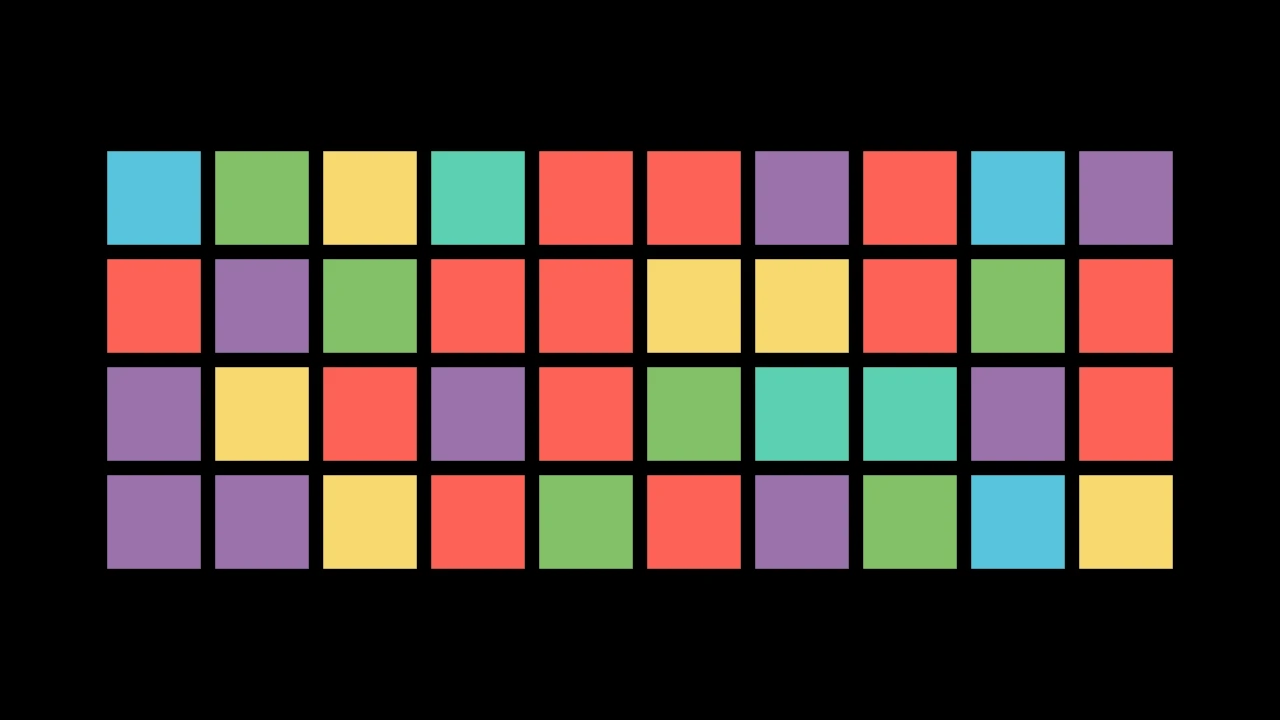
Code
import manimgx as m


class RandomColorGeneratorExample(m.Scene):
    def construct(self) -> None:
        palette = [m.RED, m.GREEN, m.BLUE, m.YELLOW, m.PURPLE, m.TEAL]
        colors = m.RandomColorGenerator(seed=7, sample_colors=palette)
        squares = m.VGroup(
            *(
                m.Square(side_length=1, color=colors.next(), fill_opacity=1)
                for _ in range(40)
            )
        )
        self.add(squares.arrange_in_grid(rows=4, buff=0.2))
A stream of colors drawn at random, the same for the same seed.
seedThe seed; None for a different stream each run.
sample_colorsThe colors to draw from; None (or no colors) for the named colors.
Source
src/manimgx/drawing/paint.py