Skip to content

3D scenes

The film's code
import manimgx as m
import numpy as np


class ThreeDScenesHero(m.ThreeDScene):
    def construct(self) -> None:
        axes = m.ThreeDAxes(
            x_range=[-3, 3],
            y_range=[-3, 3],
            z_range=[0, 2],
            x_length=7,
            y_length=7,
            z_length=3,
        )

        def height(u: float, v: float) -> np.ndarray:
            return axes.c2p(u, v, 2 * np.exp(-(u**2 + v**2) / 2))

        hill = m.Surface(height, u_range=[-2.5, 2.5], v_range=[-2.5, 2.5])
        title = m.Text("A hill", font_size=40).to_corner(m.UL)
        self.add_fixed_in_frame_mobjects(title)
        self.add(axes, hill)
        self.move_camera(phi=65 * m.DEGREES, theta=-45 * m.DEGREES, run_time=2)
        self.begin_ambient_camera_rotation(rate=0.3)
        self.wait(3)

A 3D scene is a scene whose camera looks at the frame from an angle. Two angles give it: phi, from straight above (0 looks straight down, as a flat scene does), and theta, around the vertical axis. The camera stays aimed at the frame's center; it shows the scene in perspective, and what is nearer covers what is farther.

ThreeDScene

ThreeDSceneExample
Code
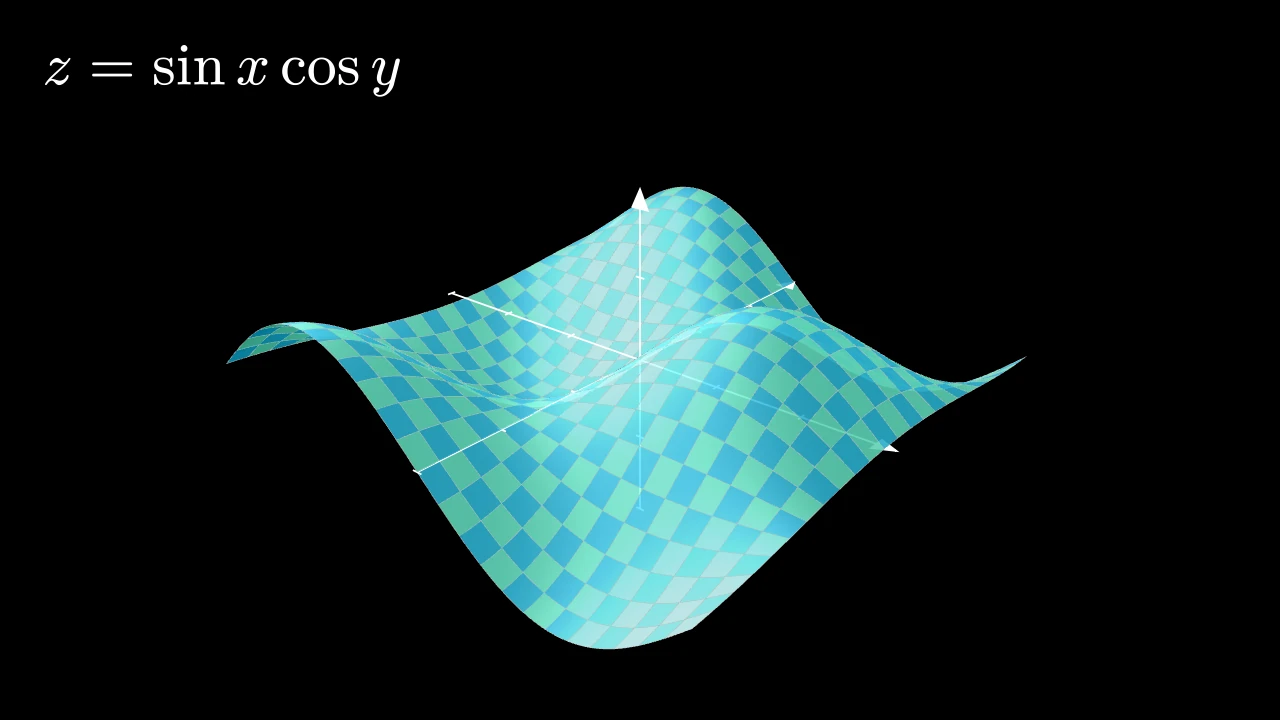
import numpy as np

import manimgx as m


class ThreeDSceneExample(m.ThreeDScene):
    def construct(self) -> None:
        self.set_camera_orientation(
            phi=65 * m.DEGREES, theta=-50 * m.DEGREES, zoom=0.6
        )
        axes = m.ThreeDAxes(x_range=(-3, 3), y_range=(-3, 3), z_range=(-2, 2))
        surface = m.Surface(
            lambda u, v: axes.c2p(u, v, np.sin(u) * np.cos(v)),
            u_range=(-3, 3),
            v_range=(-3, 3),
            resolution=(24, 24),
        ).set_fill_by_checkerboard(m.BLUE_D, m.TEAL, opacity=0.9)
        title = m.MathTex(r"z = \sin x \cos y", font_size=64).to_corner(m.UL)
        self.add_fixed_in_frame_mobjects(title)
        self.add(axes, surface)

A scene seen in three dimensions: from a camera that orbits it, with perspective and depth.

The camera looks at the center of its frame from the angles phi, from the z axis (0 looks straight down on the xy plane), and theta, around it (−90° by default, so that x points right); gamma turns it about its line of sight, zoom magnifies, and focal_distance is how far it is from the point it looks at. Each is a value tracker of the camera, so it moves as any mobject does: move_camera animates it, and an ambient rotation keeps it turning. Nearer surfaces hide farther ones; mobjects fixed in the frame are drawn flat on the screen, over everything.

class MyScene(m.ThreeDScene):
Source

src/manimgx/scene.py

def __init__(self) -> None:
    clock.reset()  # a new world: its clock at 0
    self.camera = Camera(three_d=self.three_d)
    """The scene's camera: what a frame shows. Move, scale or animate its
    [`frame`][manimgx.Camera.frame] to pan and zoom."""
    self.mobjects: list[Mobject] = []
    """The mobjects the scene holds, in drawing order: each is drawn over those
    before it, at an equal z-index. [`add`][manimgx.Scene.add] and
    [`remove`][manimgx.Scene.remove] change it."""
    self.foreground_mobjects: list[Mobject] = []
    """The mobjects kept in front: drawn over all the others, at an equal z-index
    (see [`add_foreground_mobjects`][manimgx.Scene.add_foreground_mobjects]). They
    are among the scene's [`mobjects`][manimgx.Scene.mobjects] too."""
    self.updaters: list[Callable[[float], object]] = []
    """The scene's own updaters, in the order they run (see
    [`add_updater`][manimgx.Scene.add_updater])."""
    self._since: dict[object, Fraction] = {}  # when each scene updater was last run
    self.clock = Fraction(0)
    """The scene's time, exact: a fraction of seconds (see
    [`time`][manimgx.Scene.time])."""
    self.frame = 0
    """How many frames the scene has recorded: the number of the next one, which
    shows the world at `frame / fps` seconds."""
    self._records = False  # does anything record the world (`_recording`), this run
    # the play's instants no frame shows, with what each concerns (`_exact`, `_ticks`)
    self._events: dict[Fraction, Concern | None] = {}
    self._playing: list[Mobject] = []  # what the play running acts on (`_running`)
    # while animations begin together (`_together`): what the scene held, by id, and
    # the list of mobjects it was found in (`_introduce`)
    self._beginning = False
    self._holding: tuple[list[Mobject], set[int]] | None = None
    # the play running: its animations may hide parts of the scene (`display_list`)
    self._animation: Animation | None = None
    self.num_plays = 0
    """How many plays and waits the scene has run."""
    self.film = Film()
    """The film the scene records: [`render`][manimgx.Scene.render] makes a new one,
    and returns it."""

set_camera_orientation

Set where the camera looks from, at once: each setting given; the others stay as they are.

self.set_camera_orientation(phi=None, theta=None, gamma=None, zoom=None, focal_distance=None, frame_center=None)
phi

The angle between the camera's line of sight and the z axis, in radians: 0 looks straight down on the xy plane.

theta

The camera's angle around the z axis, in radians, counterclockwise from the x axis: at −90° it looks from the side of negative y, so that x points right.

gamma

How far the camera turns about its line of sight, in radians.

zoom

How much the camera magnifies: 2 shows everything twice as large.

focal_distance

The camera's distance from the point it looks at, in scene units: the nearer, the stronger the perspective.

frame_center

The point the camera looks at, or a mobject whose center it is: the camera's frame moves there.

Source

src/manimgx/scene.py

def set_camera_orientation(
    self,
    phi: float | None = None,
    theta: float | None = None,
    gamma: float | None = None,
    zoom: float | None = None,
    focal_distance: float | None = None,
    frame_center: Point3DLike | Mobject | None = None,
) -> None:
    """Set where the camera looks from, at once: each setting given; the others stay
    as they are.

    Args:
        phi: The angle between the camera's line of sight and the z axis, in
            radians: 0 looks straight down on the xy plane.
        theta: The camera's angle around the z axis, in radians, counterclockwise
            from the x axis: at −90° it looks from the side of negative y, so that x
            points right.
        gamma: How far the camera turns about its line of sight, in radians.
        zoom: How much the camera magnifies: 2 shows everything twice as large.
        focal_distance: The camera's distance from the point it looks at, in scene
            units: the nearer, the stronger the perspective.
        frame_center: The point the camera looks at, or a mobject whose center it
            is: the camera's frame moves there.
    """
    cam = self.camera
    for value, tracker in (
        (phi, cam.phi_tracker),
        (theta, cam.theta_tracker),
        (gamma, cam.gamma_tracker),
        (zoom, cam.zoom_tracker),
        (focal_distance, cam.focal_distance_tracker),
    ):
        if value is not None:
            tracker.set_value(value)
    if frame_center is not None:
        cam.frame.move_to(frame_center)

begin_ambient_camera_rotation

Code
import manimgx as m


class ThreeDSceneAmbientRotationExample(m.ThreeDScene):
    def construct(self) -> None:
        self.set_camera_orientation(
            phi=70 * m.DEGREES, theta=-45 * m.DEGREES
        )
        torus = m.Torus(major_radius=2.5, minor_radius=0.8)
        self.add(m.ThreeDAxes(), torus.set_color(m.TEAL))
        self.begin_ambient_camera_rotation(rate=m.PI / 4)  # 45° a second
        self.wait(4)

Start turning the camera steadily, through plays and waits alike, until stop_ambient_camera_rotation.

One of the camera's angles grows at a steady rate: its tracker gets an updater (a flow) and joins the scene.

self.begin_ambient_camera_rotation(rate=0.02, about='theta')
rate

How fast the angle grows, in radians per second; a negative rate turns the other way.

about

The angle: "theta" (around the z axis), "phi" or "gamma", in any case.

Source

src/manimgx/scene.py

def begin_ambient_camera_rotation(
    self, rate: float = 0.02, about: str = "theta"
) -> None:
    """Start turning the camera steadily, through plays and waits alike, until
    `stop_ambient_camera_rotation`.

    One of the camera's angles grows at a steady rate: its tracker gets an updater
    (a [flow][manimgx.mobject.flow]) and joins the scene.

    Args:
        rate: How fast the angle grows, in radians per second; a negative rate turns
            the other way.
        about: The angle: "theta" (around the z axis), "phi" or "gamma", in any
            case.

    Examples:
        ```python
        import manimgx as m


        class ThreeDSceneAmbientRotationExample(m.ThreeDScene):
            def construct(self) -> None:
                self.set_camera_orientation(
                    phi=70 * m.DEGREES, theta=-45 * m.DEGREES
                )
                torus = m.Torus(major_radius=2.5, minor_radius=0.8)
                self.add(m.ThreeDAxes(), torus.set_color(m.TEAL))
                self.begin_ambient_camera_rotation(rate=m.PI / 4)  # 45° a second
                self.wait(4)
        ```
    """
    tracker = self._tracker(about)
    tracker.add_updater(flow(lambda m, dt: m.increment_value(rate * dt)))
    self.add(tracker)

stop_ambient_camera_rotation

Stop turning the camera: every updater of the angle's tracker is removed, and the tracker leaves the scene. The camera stays where it turned to.

self.stop_ambient_camera_rotation(about='theta')
about

The angle: "theta", "phi" or "gamma", in any case.

Source

src/manimgx/scene.py

def stop_ambient_camera_rotation(self, about: str = "theta") -> None:
    """Stop turning the camera: every updater of the angle's tracker is removed, and
    the tracker leaves the scene. The camera stays where it turned to.

    Args:
        about: The angle: "theta", "phi" or "gamma", in any case.
    """
    tracker = self._tracker(about)
    tracker.clear_updaters()
    self.remove(tracker)

begin_3dillusion_camera_rotation

Start swaying the camera around its orientation, for an illusion of depth, through plays and waits alike, until stop_3dillusion_camera_rotation.

The camera circles a little: theta swings 0.2 radians either side of origin_theta, and phi between origin_phi and 0.2 radians less, a quarter of a cycle apart. The trackers of the two angles get updaters (flows) and join the scene.

self.begin_3dillusion_camera_rotation(rate=1, origin_phi=None, origin_theta=None)
rate

How fast it sways, in radians of its cycle per second: a cycle takes 2π / rate seconds.

origin_phi

The phi it sways from; None for the camera's present one.

origin_theta

The theta it sways about; None for the camera's present one.

Source

src/manimgx/scene.py

def begin_3dillusion_camera_rotation(
    self,
    rate: float = 1,
    origin_phi: float | None = None,
    origin_theta: float | None = None,
) -> None:
    """Start swaying the camera around its orientation, for an illusion of depth,
    through plays and waits alike, until `stop_3dillusion_camera_rotation`.

    The camera circles a little: `theta` swings 0.2 radians either side of
    `origin_theta`, and `phi` between `origin_phi` and 0.2 radians less, a quarter
    of a cycle apart. The trackers of the two angles get updaters (flows) and join
    the scene.

    Args:
        rate: How fast it sways, in radians of its cycle per second: a cycle takes
            2π / `rate` seconds.
        origin_phi: The `phi` it sways from; None for the camera's present one.
        origin_theta: The `theta` it sways about; None for the camera's present one.
    """
    cam = self.camera
    origin_theta = cam.get_theta() if origin_theta is None else origin_theta
    origin_phi = cam.get_phi() if origin_phi is None else origin_phi
    clocks = [0.0, 0.0]

    def swing_theta(m: ValueTracker, dt: float) -> None:
        clocks[0] += dt * rate
        m.set_value(origin_theta + 0.2 * np.sin(clocks[0]))

    def swing_phi(m: ValueTracker, dt: float) -> None:
        clocks[1] += dt * rate
        m.set_value(origin_phi + 0.1 * np.cos(clocks[1]) - 0.1)

    cam.theta_tracker.add_updater(flow(swing_theta))
    cam.phi_tracker.add_updater(flow(swing_phi))
    self.add(cam.theta_tracker, cam.phi_tracker)

stop_3dillusion_camera_rotation

Stop swaying the camera: every updater of the theta and phi trackers is removed, and they leave the scene. The camera stays where the sway left it.

self.stop_3dillusion_camera_rotation()
Source

src/manimgx/scene.py

def stop_3dillusion_camera_rotation(self) -> None:
    """Stop swaying the camera: every updater of the `theta` and `phi` trackers is
    removed, and they leave the scene. The camera stays where the sway left it."""
    for tracker in (self.camera.theta_tracker, self.camera.phi_tracker):
        tracker.clear_updaters()
        self.remove(tracker)

move_camera

Code
import manimgx as m


class ThreeDSceneMoveCameraExample(m.ThreeDScene):
    def construct(self) -> None:
        cube = m.Cube(side_length=2.5, fill_opacity=0.8, fill_color=m.BLUE)
        self.add(m.ThreeDAxes(), cube)
        self.move_camera(
            phi=70 * m.DEGREES, theta=-45 * m.DEGREES, run_time=2
        )
        self.move_camera(theta=45 * m.DEGREES, zoom=1.5, run_time=2)

Animate the camera to a new orientation, in one play: each setting given; the others stay as they are.

Each setting moves steadily from its value to the new one, eased by the rate function, so a theta 2π greater takes the camera once around. The frame moves to frame_center if given, and added_anims play along.

self.move_camera(phi=None, theta=None, gamma=None, zoom=None, focal_distance=None, frame_center=None, added_anims=(), **kwargs)
phi

The angle between the camera's line of sight and the z axis, in radians: 0 looks straight down on the xy plane.

theta

The camera's angle around the z axis, in radians, counterclockwise from the x axis.

gamma

How far the camera turns about its line of sight, in radians.

zoom

How much the camera magnifies: 2 shows everything twice as large.

focal_distance

The camera's distance from the point it looks at, in scene units.

frame_center

The point for the camera to look at, or a mobject whose center it is.

added_anims

Animations to play along.

run_time

How long the animation plays, in seconds (default 1).

lag_ratio

How the parts of the mobject are staggered: each begins this fraction of its run after the one before it begins (default 0: all together; 1: one after another).

rate_func

How the animation's progress runs with time: a function from [0, 1] to [0, 1] (default smooth; see rate functions).

reverse_rate_function

Whether to run the animation backward (default False).

name

A name for the animation.

remover

Whether the mobject leaves the scene when the animation finishes (default False).

suspend_mobject_updating

Whether the mobject's updaters run beneath the animation (default True): they keep acting on the mobject, and each frame shows the animation applied to the result. If False, they act on the animated mobject itself.

introducer

Whether the mobject joins the scene when the animation begins (default False); otherwise the play brings it in when the play begins, if the scene lacks it.

use_override

Whether a mobject whose class plays another animation in place of this one does so (default True).

It also takes the transform keywords.

Source

src/manimgx/scene.py

def move_camera(
    self,
    phi: float | None = None,
    theta: float | None = None,
    gamma: float | None = None,
    zoom: float | None = None,
    focal_distance: float | None = None,
    frame_center: Point3DLike | Mobject | None = None,
    added_anims: Sequence[Animation] = (),
    **kwargs: Unpack[TransformOptions],
) -> None:
    """Animate the camera to a new orientation, in one play: each setting given; the
    others stay as they are.

    Each setting moves steadily from its value to the new one, eased by the rate
    function, so a `theta` 2π greater takes the camera once around. The frame moves
    to `frame_center` if given, and `added_anims` play along.

    Args:
        phi: The angle between the camera's line of sight and the z axis, in
            radians: 0 looks straight down on the xy plane.
        theta: The camera's angle around the z axis, in radians, counterclockwise
            from the x axis.
        gamma: How far the camera turns about its line of sight, in radians.
        zoom: How much the camera magnifies: 2 shows everything twice as large.
        focal_distance: The camera's distance from the point it looks at, in scene
            units.
        frame_center: The point for the camera to look at, or a mobject whose center
            it is.
        added_anims: Animations to play along.
        **kwargs: [Transform options][manimgx.animation.transform.TransformOptions] for
            every animation of the play, the added ones too.

    Examples:
        ```python
        import manimgx as m


        class ThreeDSceneMoveCameraExample(m.ThreeDScene):
            def construct(self) -> None:
                cube = m.Cube(side_length=2.5, fill_opacity=0.8, fill_color=m.BLUE)
                self.add(m.ThreeDAxes(), cube)
                self.move_camera(
                    phi=70 * m.DEGREES, theta=-45 * m.DEGREES, run_time=2
                )
                self.move_camera(theta=45 * m.DEGREES, zoom=1.5, run_time=2)
        ```
    """
    cam = self.camera
    pairs = (
        (phi, cam.phi_tracker),
        (theta, cam.theta_tracker),
        (focal_distance, cam.focal_distance_tracker),
        (gamma, cam.gamma_tracker),
        (zoom, cam.zoom_tracker),
    )
    anims: list[Animation] = [
        tracker.animate.set_value(value)
        for value, tracker in pairs
        if value is not None
    ]
    if frame_center is not None:
        anims.append(cam.frame.animate.move_to(frame_center))
    self.play(*anims, *added_anims, **kwargs)
    if frame_center is not None:
        self.remove(cam.frame)

add_fixed_in_frame_mobjects

Add mobjects pinned to the screen: each is drawn where its points are, as in a two-dimensional view centered on the origin, over everything else.

They are added to the scene, and stay where they are on the screen whatever the camera's angles, zoom and center: a title placed with to_corner stays in its corner. Everything in them is pinned, now and later: a member added later (a number's new digits, what an updater or a Transform makes) is pinned too.

self.add_fixed_in_frame_mobjects(*mobjects)
Source

src/manimgx/scene.py

def add_fixed_in_frame_mobjects(self, *mobjects: Mobject) -> None:
    """Add mobjects pinned to the screen: each is drawn where its points are, as in
    a two-dimensional view centered on the origin, over everything else.

    They are added to the scene, and stay where they are on the screen whatever the
    camera's angles, zoom and center: a title placed with `to_corner` stays in its
    corner. Everything in them is pinned, now and later: a member added later (a
    number's new digits, what an updater or a Transform makes) is pinned too.
    """
    self.add(*mobjects)
    self.camera.add_fixed_in_frame_mobjects(*mobjects)